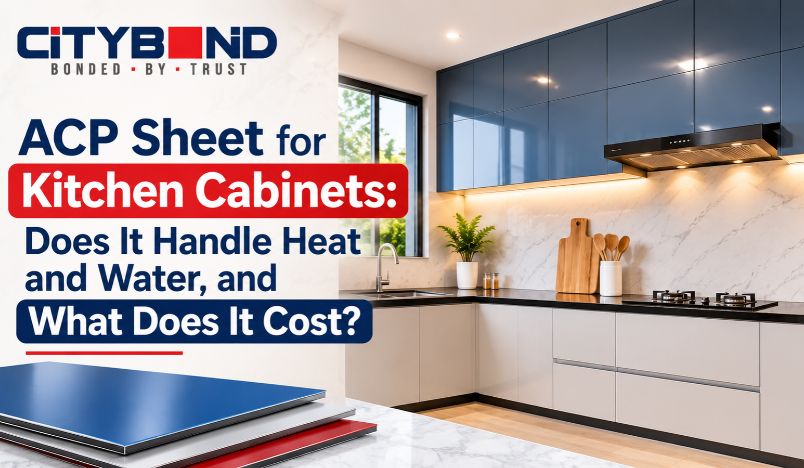
Indian kitchens are hard on materials. Tadka heat, steam, oil splatter, monsoon humidity and daily washing around the sink punish every surface. Plywood and MDF swell when water get in, and laminates peel at the edges. So many homeowners and fabricators are now asking whether an Aluminium Composite Panel (ACP), long used on building facades, can work indoors, especially as an ACP sheet for kitchen cabinets.
Quick answer: Yes, with the right grade and the right placement. Coated aluminium does not absorb water, and fire-retardant (FR) grades handle kitchen heat well. The rules are to seal every edge and to keep ACP away from direct flame. Panel cost typically starts around ₹55 per sq.ft. and rises with thickness and fire rating.
What is an ACP sheet?
An ACP is a sandwich panel. Two thin aluminium skins carry the colour, finish and strength, and a core between them keeps the panel flat, light and easy to cut and fold. There are two core types:
- Standard polyethylene (PE/LDPE) core: light, economical and suited to general interiors
- Fire-retardant (FR) mineral core: filled with minerals that slow combustion, and the better choice where heat and safety matter. See Citybond’s fire-retardant ACP range
Kitchen interiors usually use 3 mm panels. Thicker 4 mm and 6 mm grades are mostly chosen for FR and commercial applications.
Does ACP handle water and moisture?
Mostly yes, and this is where it clearly beats wood-based boards. Water cannot soak into a coated aluminium surface, so there is nothing to swell, warp or rot. Wood fibre is what termites feed on, and ACP has none, so it resists termites and fungus. Oil, turmeric and spice stains wipe off with a damp cloth and mild dish soap.
The honest caveat is that ACP is a surface, not a complete cabinet. The weak points are cut edges, joints, screw holes and the base board behind the panel. If water gets in there, even a waterproof face cannot save the cabinet. Good fabricators seal every edge and use quality adhesive, so treat “waterproof” as a property of the panel’s face, not of the whole cabinet.
Manufacturing quality matters here too. Ask for evidence of humidity, boiling-water and coating-adhesion tests, especially for coastal cities like Mumbai, Chennai and Kochi. Citybond, for example, runs 31+ in-house quality tests, including humidity and salt spray tests.
Does ACP handle heat?
“Heat” means two different things in a kitchen.
Everyday warmth: Heat from cooking, a hot kettle or a nearby microwave is not a problem. Aluminium melts at around 660°C, far beyond anything a home kitchen produces. ACP also expands very little when warmed. Citybond’s technical data lists thermal expansion of about 2.4 mm per metre per 100°C, so panels stay dimensionally stable.
Direct flame and high heat: Here the core decides the outcome. A standard PE core is a plastic and softens far below the temperature of aluminium, so standard ACP should never sit right next to a burner.
Fire-retardant ACP uses a mineral core to improve fire performance. Citybond’s FR range uses halogen-free minerals (magnesium hydroxide and aluminium trihydroxide), and its B1 grade is about 70% mineral. Fire ratings appear as codes under EN 13501-1, the European fire classification standard:
- B-s1-d0: very limited contribution to fire, very low smoke (s1) and no flaming droplets (d0). This is the class for Citybond’s B1 grade
- A2-s1-d0: a higher class with no significant contribution to fire (limited combustibility), with the same low smoke and no droplets. This is the class for Citybond’s A2 grade
“Fire-retardant” does not mean fireproof. Ask for the test certificate for the exact grade you are buying before specifying it.
A simple zone guide for your kitchen
- Shutters, drawer fronts and tall units away from the hob: standard ACP works well. Choose FR if you want extra safety
- Panels beside the hob, chimney or oven: use FR-core ACP and leave a small air gap. Check the appliance maker’s clearances
- Directly behind the burners: do not use ACP. Use stainless steel, toughened glass or tile
How ACP is actually used in kitchen cabinets
ACP is usually the finishing skin, not the whole cabinet. A 3 mm panel is bonded over a base board such as marine plywood and replaces laminate or paint on the outside. You get a regular cabinet’s carpentry with a wipe-clean, moisture-resistant face. Fabricators can also V-groove and fold ACP into rounded, edge-band-free shutter returns, which keeps grease and water out of the edges.
A fabricator’s tip: hinges, channels and handles are screwed into the base board, not into the 3 mm panel alone. So, the board matters as much as the face. Use a boiling-water-resistant or marine-grade plywood (IS 710) for the carcass, especially under the sink.
Finishes go well beyond the “industrial” look:
- Wood grains: timber warmth without moisture risk
- Marble and stone textures: a luxury look at a fraction of the weight
- Gloss and metallic: suited to handleless, modern kitchens
- Matte and satin: fingerprint-resistant, for minimalist layouts
ACP vs HPL vs laminate on plywood
| Feature | ACP (FR core) | HPL sheet | Laminate on plywood |
| Water resistance | Face is waterproof; seal edges | Good; seal edges | Edges and joints are the weak point |
| Heat tolerance | Good with FR core; avoid direct flame | Good | Moderate; keep away from flame |
| Weight | Light | Heavier | Depends on the board |
| Finishes | Wood, marble, gloss, metallic, solid | Wood and solid patterns | Very wide |
| Cleaning | Damp cloth | Wipe clean | Wipe clean; avoid soaking |
| Upfront cost | Mid-range | Mid to high | Usually lowest |
No material is best for every kitchen. Compare the whole system, including carcass, hardware and installation, not just the visible surface. Citybond makes both ACP and HPL sheets, so our team can advise on either.
What does an ACP sheet for kitchen cabinets cost in India?
Separate the panel cost from the finished kitchen cost.
Indicative market price per sq.ft., before 18% GST, as of [MONTH YEAR]: [CONFIRM these ranges against Citybond’s current price list]
| Type | Indicative price per sq.ft. |
| 3 mm standard PE core, plain or wooden finish | ₹55 to ₹110 |
| 3 mm to 4 mm FR B1 core | ₹120 to ₹270 |
| 4 mm FR A2 core | ₹200 to ₹320 |
Final rates depend on:
- Total thickness and aluminium skin thickness
- Core type (PE or FR)
- Coating and finish
- Order quantity and city
- Cutting waste
Compare quotes carefully: Confirm whether the price is per sheet, per sq.ft. or per sq.m., and whether GST is included. Standard sheets come in 8×4 ft (32 sq.ft.), with 10×4 and 12×4 ft sizes for full-height units with fewer joints.
Finished kitchen cost: The panel is only one part of the total. Modular kitchens in Indian metros commonly run ₹1,500 to ₹3,000+ per sq.ft. once the base board, hardware, hinges, labour and countertop are included. Ask for an itemized quote.
Where ACP saves money: It needs no polishing or repainting, does not attract termites, and cleans in minutes. Over 10 to 15 years, lower upkeep can offset a slightly higher starting price.
Which ACP should you choose?
- Homes: 3 mm ACP in wood, marble or gloss finishes for shutters, with an FR core for panels near the cooking zone
- Restaurants, cloud kitchens and canteens: FR core throughout, since commercial kitchens run longer hours at higher heat
- Every project: buy from a manufacturer that can show test results and certifications, not just samples. Check for ISO 9001 certification and the BIS ISI mark under IS 17682:2021
Citybond manufactures ACP in Raipur, Chhattisgarh, at a 70,000 sq.ft. facility producing over 30 million sq.ft. a year. It offers custom Pantone colour matching within seven days and sells through 4,500+ retail counters across 74+ cities, so you can find a dealer near you and see samples in person.
Frequently asked questions
Is ACP sheet waterproof for kitchens?
The coated aluminium face is waterproof, so water and steam do not damage it. The risk lies at cut edges and joints, which must be sealed properly.
Can I use ACP near a gas stove?
Use only FR-core ACP near the cooking zone and leave an air gap. Do not fix ACP directly behind burners. Use steel, toughened glass or tile there.
Which thickness of ACP is best for kitchen cabinets?
3 mm is the usual choice for shutters and drawer fronts, bonded over a kitchen-grade base board. Choose an FR core of 3 mm to 4 mm for panels near the hob or for commercial kitchens.
Is ACP better than laminate for kitchen cabinets?
ACP has a fully waterproof face and can be folded around edges, so it handles steam and splashes better than laminate. Laminate on plywood usually costs less upfront. For wet zones such as the sink unit, ACP is often worth the difference.
How much does ACP for kitchen cabinets cost per sq.ft.?
The panel alone typically costs ₹55 to ₹320 per sq.ft. before GST, depending on thickness and fire rating. Base board, hardware and labour add to the finished price. For a quote, contact our team.
How do I clean ACP cabinets?
Wipe with a soft cloth, warm water and a drop of mild detergent. Avoid steel wool and harsh solvents like acetone, which can damage the coating.
Ready to plan your kitchen?
The right ACP grade is the difference between a kitchen that looks new for years and one that doesn’t. Share your layout and cooking setup with the Citybond team to choose the right core, thickness and finish.
Explore Citybond ACP sheets for interiors | Contact us | Find a dealer
