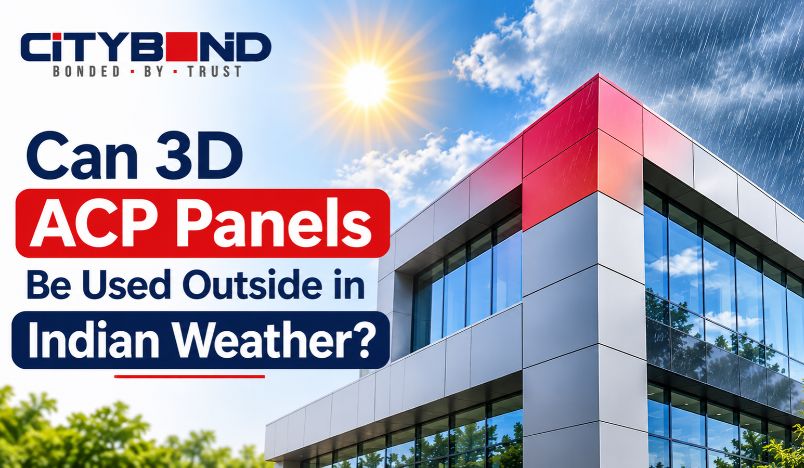
Yes, they can. Exterior-grade 3D ACP panels (often sold as 3D ACP sheets) handle Indian sun, monsoon and humidity well when three things are right: the coating, the panel grade and the installation. But not every textured panel is built for outdoor use. Those details decide whether a facade still looks sharp after ten monsoons or starts fading and rippling within two.
If you are planning a home, showroom, hotel or office exterior, here is what to know before you specify one.
What are 3D ACP panels?
An aluminium composite panel (ACP) works like a sandwich: two thin aluminium skins bonded to a core. The aluminium carries the colour and protects the panel, while the core keeps it light, flat and rigid.
A 3D ACP panel adds an embossed or textured surface, often inspired by stone, concrete or wood. The raised pattern catches light and shadow differently from morning to evening, giving a flat wall real depth. Citybond’s 3D ACP Panels Series includes finishes such as CT-291 Dholpur Pink, CT-292 Italian Grey, CT-293 Grey White and CT-294 Premium Teak.
What does Indian weather throw at a facade?
India has no single climate. A wall in Rajasthan faces different stress from one in coastal Mumbai. Four factors matter most:
- Heat and UV: India’s highest recorded temperature is 51°C, at Phalodi in 2016. Constant UV exposure fades poorly made coatings.
- Monsoon: Mumbai received 944 mm of rain in a single day in July 2005. Joints, edges and drainage must manage water, not just the panel surface.
- Coastal humidity and salt air: In Mumbai, Chennai and Kochi, moisture and airborne salts attack unprotected metal and weak fixings.
- Daily temperature swings and dust: Panels expand and contract every day, while urban dust and pollution settle on the surface.
Why exterior-grade 3D ACP performs outdoors
The coating is the raincoat: ACP colour is a factory-baked coating, not ordinary wall paint. For exteriors, PVDF (polyvinylidene fluoride) is the benchmark. Coatings that meet AAMA 2605, an international specification that measures colour retention and chalking over many years, are typically made with at least 70% PVDF resin. Standard polyester coatings, often used indoors, lack this long-term UV resistance.
Coating thickness: Coating thickness is measured in microns (thousandths of a millimetre). Citybond’s 3D panels carry a two-coat finish of 24 to 28 microns on the face and a 7-micron service coat on the back. When comparing brands, always ask which resin is used and how thick the coating is.
No rust: Aluminium does not rust. It forms its own protective oxide layer, and Citybond’s 3D panels use 0.25 mm aluminium skins on both faces. That is why ACP suits humid cities where iron fittings corrode quickly.
No swelling, rot or termites: Timber swells in the monsoon and invites termites. An aluminium face over a sealed core gives them nothing to attack and very little for water to damage.
Texture and weight help: Embossed surfaces tend to hide dust and light marks better than mirror-flat finishes. ACP is also far lighter than stone, which reduces load on the structure. This matters for older buildings and renovations.
Tested manufacturing: Citybond’s in-house laboratory runs humidity, salt-spray, impact and protective-film checks. These support quality assurance, but you should still ask for test reports on the exact product you are buying.
The detail most people miss: Thermal movement
Aluminium expands when heated, by about 0.024 mm per metre for every 1°C. That is roughly 1.4 mm per metre across a 60°C swing, or over 4 mm on a 3-metre panel. Fixed too rigidly, panels ripple or bulge.
This is why professionals mount ACP on a metal sub-frame with small joint gaps, ventilated cavities and weather-grade sealants. Each panel can then move freely, and rainwater drains instead of lingering. Exterior performance depends on the complete system, not the sheet alone.
Fire safety: Choose the right core
Standard polyethylene-core ACP suits many low-rise homes and shopfronts. For taller or public buildings, choose a fire-retardant (FR) mineral core. India’s National Building Code (NBC 2016, Part 4) applies stricter fire provisions to high-rise buildings, defined as 15 metres or more in height.
Citybond’s fire-retardant ACP uses a mineral-filled core designed to delay flame spread and reduce smoke. Confirm the core type and required test documentation with your architect and local fire authority.
3D ACP vs other exterior finishes
| Feature | 3D ACP panels | Natural stone | Textured paint/plaster | Timber |
| Weight | Light | Very heavy | Light | Medium |
| Monsoon performance | Strong with proper coating and joints | Strong, can stain | May seep or peel | Swells and rots |
| Termite risk | None | None | None | High |
| Maintenance | Periodic washing | Sealing and polishing | Repainting every few years | Regular treatment |
| Installation | Fast, dry fixing | Slow, skilled labour | Slow, wet work | Moderate |
This is a general comparison. Actual results depend on the product, specification, installation and site conditions.
Where 3D ACP works outdoors
- Homes: Front elevations, gate pillars, parapets, balcony fascias, car porches, boundary-wall feature panels and main gates (see our guide to the ACP sheet for main gate
- Commercial spaces: Showrooms, shopfronts, offices, hotels, malls and canopies. See Citybond’s exterior facade solutions
- Renovations: Assess the existing wall and supporting structure before choosing a fixing method
Think of it as a long-term decision. A painted wall needs redoing every few years, while a well-specified ACP facade needs only periodic washing.
Five checks before you buy
- Coating: Ask for the resin type and thickness in microns
- Grade and thickness: Match them to building height and wind load. Citybond lists its CB-325 (3 mm) 3D grade for medium-rise buildings. For taller, coastal or high-wind sites, consult your facade engineer about thicker grades.
- Core: Choose fire-retardant for tall or public buildings
- Warranty and testing: Citybond offers up to 15 years on select finishes, subject to terms and conditions. Read the exclusions and request test reports
- Installer: Insist on a sub-frame, expansion gaps, sealed joints and drainage provisions
Why Citybond?
Citybond manufactures ACP, HPL, Lamio and louvers at a 70,000 sq.ft. facility in Raipur, with output above 30 million sq.ft. a year, and has delivered 52,200+ projects across 74+ cities. Architects can explore Citybond for Architects.
Frequently Asked Questions
Will 3D ACP panels fade in the Indian sun?
Quality panels with a premium UV-resistant coating hold colour for years. Fading mostly affects low-grade coatings, so check resin type, micron thickness and warranty.
Can they handle heavy rain and coastal humidity?
Yes, when the complete system is right. Aluminium faces do not rust like steel, and the panel does not soak up water like wood. Correct joints, sealing and a ventilated sub-frame stop moisture collecting behind it.
How much maintenance do they need?
Very little. A periodic rinse with water and mild soap removes dust and pollution, and there is no repainting cycle. In coastal or dusty locations, inspect joints and sealants occasionally.
What thickness of 3D ACP sheet is best for exteriors?
It depends on building height, wind exposure and panel size. Citybond lists its CB-325 (3 mm) 3D grade for medium-rise buildings. For taller, coastal or high-wind sites, ask a facade engineer to specify a thicker grade.
How much does a 3D ACP sheet cost?
Prices depend on thickness, skin, coating and finish. As a guide, Citybond 3D ACP sheets cost around, excluding sub-frame and installation. For an exact quote, contact our team or find a Citybond dealer.
Can 3D ACP panels be used on a main gate?
Yes. 3D textures are among the most forgiving finishes for gates because the relief hides scratches and dust. The panel is only the skin, so it needs a strong, rust-protected frame. Read our full guide to choosing an ACP sheet for a main gate.
Build a facade that lasts
3D ACP panels can look striking and last outdoors in India when the coating, grade, core and installation are right. Citybond’s team can help you choose the right panel for your climate and building height.
